
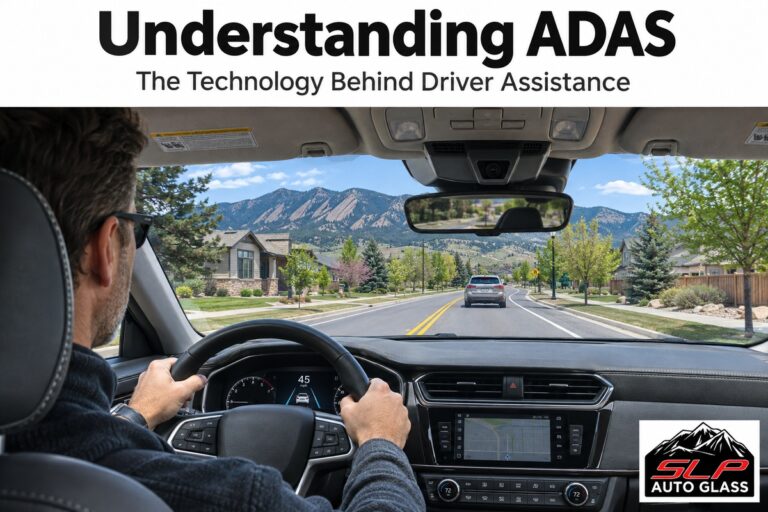
An Advanced Driver Assistance System (ADAS) is a group of electronic safety features that use cameras, radar, and sensors to help drivers avoid crashes. Most new vehicles on the road today include at least a few ADAS features, and many of them depend directly on your windshield.
For drivers, that connection matters. A cracked or poorly installed windshield can affect how your ADAS performs. This guide covers how these systems work, the features you are likely to have, the safety data behind them, and what to know before replacing auto glass.
How ADAS Works in Modern Vehicles
ADAS relies on a network of sensors that constantly collect information about the road, nearby vehicles, and pedestrians. A control module processes that data in milliseconds and triggers a warning or an automatic response.
Cameras and Windshield Mounted Sensors
The forward-facing camera is usually mounted behind the rearview mirror, looking through the windshield. It reads lane markings, traffic signs, vehicles, and pedestrians.
Because the camera looks through the glass, the windshield becomes part of the system. Clarity, thickness, and the angle of the glass all influence what the camera sees.
Radar, Ultrasonic, and Lidar Sensors
Radar sensors are typically placed in the front grille or bumper. They measure the distance and speed of objects ahead, which supports features like adaptive cruise control.
Ultrasonic sensors handle short-range detection for parking assistance. Some vehicles also use lidar for detailed mapping of the surroundings.
The Control Module
The ADAS control unit combines data from every sensor. It decides whether to alert the driver, apply the brakes, or adjust steering input.
Common ADAS Features Drivers Use Every Day
Most drivers use ADAS features without thinking about the technology behind them. Here are the ones you will see most often.
Automatic Emergency Braking
Automatic emergency braking (AEB) detects a possible frontal collision and applies the brakes if the driver does not respond in time. Many versions also detect pedestrians and cyclists.
Lane Departure Warning and Lane Keeping Assist
Lane departure warning alerts you when the vehicle drifts out of its lane without a turn signal. Lane keeping assist goes a step further and gently steers the car back.
Both features depend on the windshield camera reading lane lines accurately.
Adaptive Cruise Control
Adaptive cruise control keeps a set following distance from the vehicle ahead. It slows down and speeds up automatically, which reduces fatigue on long highway drives.
Blind Spot Monitoring and Rear Cross Traffic Alert
Blind spot monitoring warns you about vehicles in adjacent lanes. Rear cross traffic alert detects approaching vehicles when you back out of a parking space.
Other common features include:
- Traffic sign recognition
- Driver attention monitoring
- Surround view cameras
- Parking assist
- Automatic high beams
ADAS Safety Statistics
The data behind ADAS explains why automakers and regulators continue to push for wider adoption.
Crash Reduction Data
The Insurance Institute for Highway Safety (IIHS) has reported the following findings from real-world crash studies:
- Automatic emergency braking can cut rear-end crashes by about 50 percent.
- Forward collision warning alone reduces rear-end crashes by roughly 27 percent.
- Blind spot detection lowers lane-change crashes by about 14 percent.
- Lane departure warning reduces single-vehicle, sideswipe, and head-on injury crashes by about 21 percent.
These numbers show how much a working system can reduce risk, which is why keeping ADAS accurate after glass repair matters.
Federal Requirements
The National Highway Traffic Safety Administration (NHTSA) finalized a rule in 2024 requiring automatic emergency braking on all new light vehicles by September 2029. As a result, ADAS will soon be standard on nearly every passenger vehicle sold in the United States.
ADAS and Your Windshield
The windshield is one of the most important parts of the ADAS setup, yet many drivers do not realize it until they need a replacement.
Why the Camera Depends on Glass Quality
The camera needs a clear, distortion-free view. Poor quality glass, incorrect tint bands, or a slightly different curvature can change how the camera interprets the road.
Even a small shift in camera position can cause the system to misjudge distance or lane placement.
When Replacement Requires ADAS Recalibration
If your vehicle has a windshield-mounted camera, a replacement almost always requires recalibration. The camera has to be mounted and aimed precisely to match the manufacturer’s specifications.
Recalibration is also commonly needed after:
- Windshield replacement
- Front-end collision repair
- Wheel alignment or suspension work
- Replacement of the camera or radar unit
- Bumper or grille repair that involves sensors
AAA testing has shown that cameras that are off by even a small amount can cause lane keeping and braking systems to perform poorly.
ADAS Calibration Explained
Calibration restores the sensors to their exact factory settings so the system reads the road correctly.
Static vs Dynamic Calibration
Static calibration happens in a controlled shop environment. Technicians place targets at measured distances in front of the vehicle and use diagnostic equipment to align the camera.
Dynamic calibration is done on the road. The vehicle is driven at specific speeds under proper conditions, usually with clear lane markings, while a scan tool guides the process.
Some vehicles need one method, and others require both. The manufacturer determines which one applies.
Cost and Time
ADAS calibration commonly runs from around $150 to $500 or more, depending on the make, model, and type of calibration. Dealer pricing is often higher.
Most calibrations take between 30 minutes and a few hours. Pairing the calibration with your windshield replacement is usually the most efficient option.
Signs Your ADAS Needs Attention
A system that is out of alignment does not always make itself obvious. Knowing what to watch for helps you catch problems early.
Dashboard Warning Lights
Many vehicles display a message or an icon when the ADAS detects a fault or loses calibration. Common messages include “Front Camera Unavailable” or “Driver Assist System Error.”
Inconsistent System Behavior
Pay attention to changes in how your vehicle responds. Warning signs include:
- Lane assist drifting or pulling to one side
- Phantom braking with no obstacle ahead
- Adaptive cruise control following too close or too far
- Lane departure alerts that trigger constantly or never
- Camera features turning off after a windshield replacement
If you notice any of these, have the system scanned and checked.
Choosing an Auto Glass Shop for ADAS Windshield Replacement
Not every shop is equipped to handle ADAS vehicles. The right choice protects both your windshield and your safety systems.
Questions to Ask Before You Book
A reliable shop should be able to answer these clearly:
- Do you perform static, dynamic, or both types of calibration?
- Will you provide a calibration report after the service?
- Do you follow the vehicle manufacturer’s procedures?
- Is the calibration included in the quote?
OEM vs Aftermarket Glass
OEM glass matches the original manufacturer specifications. High-quality aftermarket glass can also work well, but it must meet the right optical and fit standards for camera-equipped vehicles.
Ask your technician which option is best for your specific model and sensor setup.
An Advanced Driver Assistance System only works as well as the glass and calibration behind it. If your windshield needs repair or replacement, SLP Autoglass can help make sure your camera and sensors are properly set up so your safety features perform the way they were designed to.